
Bruges and Ghent in One Day: Complete Guide
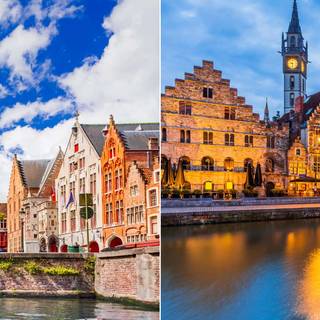
Bruges and Ghent are the two most beautiful cities in Belgium and are just 30 minutes apart by train. Is it possible to see both in a single day? Yes, and here's how to do it, how to get there, and what to see in each city to make the most of your visit.
Free Walking Tour Bruges
Bruges Mysteries & Legends Free Night Tour
Ghent Free Walking Tour : Legends of Ghent
Ghent Free Evening Tour: The Dark Side of Ghent
Visiting Bruges and Ghent in one day is entirely doable, and in fact it's one of the most popular itineraries among travellers exploring Belgium. Both cities are very well connected by train: Ghent is just 30 minutes from Bruges and 35 minutes from Brussels. If you'd like to spend more time, check out our complete guide to Bruges in 3 days. Not sure how long to stay? Read our guide on how many days you need in Bruges.
How to Organise the Day: Bruges in the Morning, Ghent in the Afternoon
The best way to structure the day is to start in Bruges, which is further from Brussels, and head to Ghent after lunch. From Bruges train station, the city centre is a 10-minute walk.
How to Get from Brussels to Bruges and Ghent
There are several ways to do this trip:
By train is the most flexible and affordable option. From Brussels (Brussel-Centraal or Brussel-Zuid) there are frequent trains to Bruges (approx. 1h) and to Ghent-Sint-Pieters (35 min). The train between Bruges and Ghent takes about 30 minutes. Tickets can be bought on the SNCB website (Belgian railways) or at machines in the station.
By car is also feasible: Brussels to Bruges is about 100 km via the E40 (approx. 1h). From Bruges to Ghent is 55 km (about 45 min). Bear in mind that Ghent city centre has a Low Emission Zone (LEZ) with restricted access; the most convenient option is to park in one of the P+R car parks on the outskirts and take the tram in.
Free Walking Tour Bruges
Bruges Mysteries & Legends Free Night Tour
Ghent Free Walking Tour : Legends of Ghent
Ghent Free Evening Tour: The Dark Side of Ghent
Bruges in the Morning: What to See in Half a Day

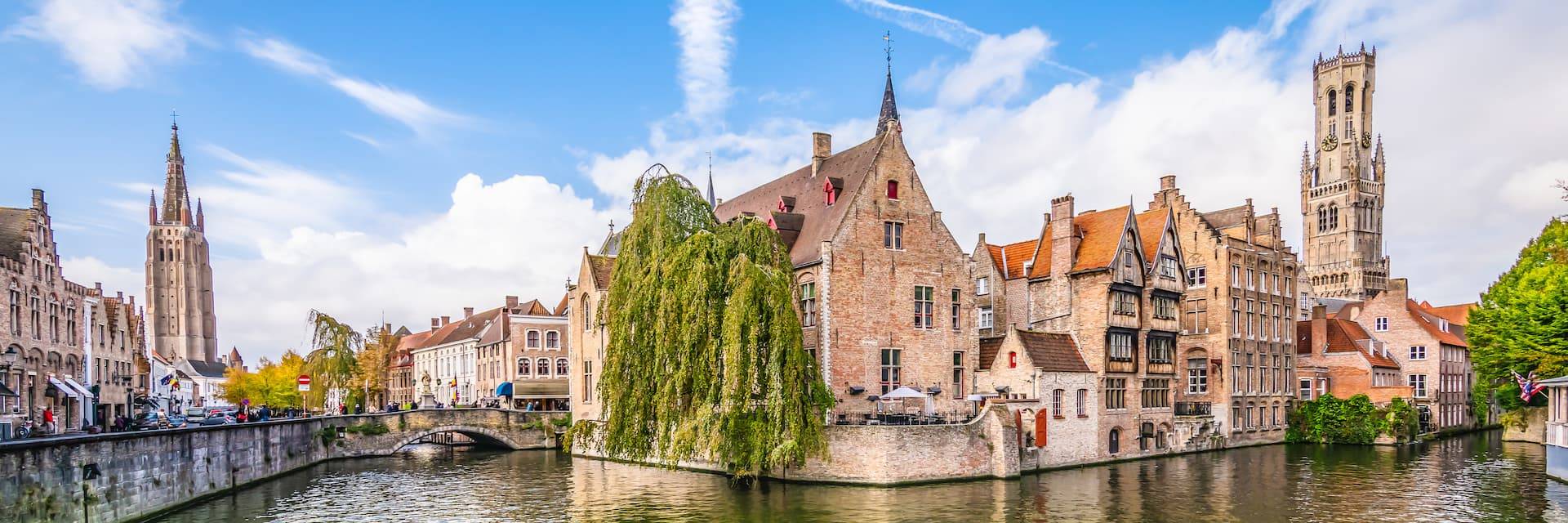
The canals of Bruges with their swans, symbol of the most beautiful medieval city in Belgium
Bruges looks like it was lifted straight from a fairy tale. We recommend exploring beyond the main sights and letting yourself get lost in its narrow streets — the city's real charm is around every corner. A great way to discover the essentials is with the Free Walking Tour of Bruges, which covers the most important highlights in around 2 hours with a knowledgeable guide.
Grote Markt and the Belfry
The main square of Bruges is the beating heart of the city. It is dominated by the Belfry (83 metres tall), from the top of which you get the best panoramic views in the city. Surrounded by Flemish facades from the 16th and 17th centuries, the square also features the Landhuis, a neo-Gothic provincial palace.
Burg Square
Just steps from the Grote Markt, Burg Square is home to the 14th-century Gothic Town Hall — the oldest in Belgium — the Renaissance Palace of Justice and the striking Basilica of the Holy Blood. To reach the canals from here, you pass through the famous Blind Donkey Alley, one of the most photographed corners of the city.

The Belfry tower presides over the Grote Markt in Bruges, the heart of the city
The Canals: Dijver and Groenrei
Once through the alley, you enter the most bucolic part of Bruges. The Dijver and Groenrei canals, with their swans gliding past, are the absolute symbol of the city. Stroll at your own pace and soak up the atmosphere.
Rozenhoedkaai
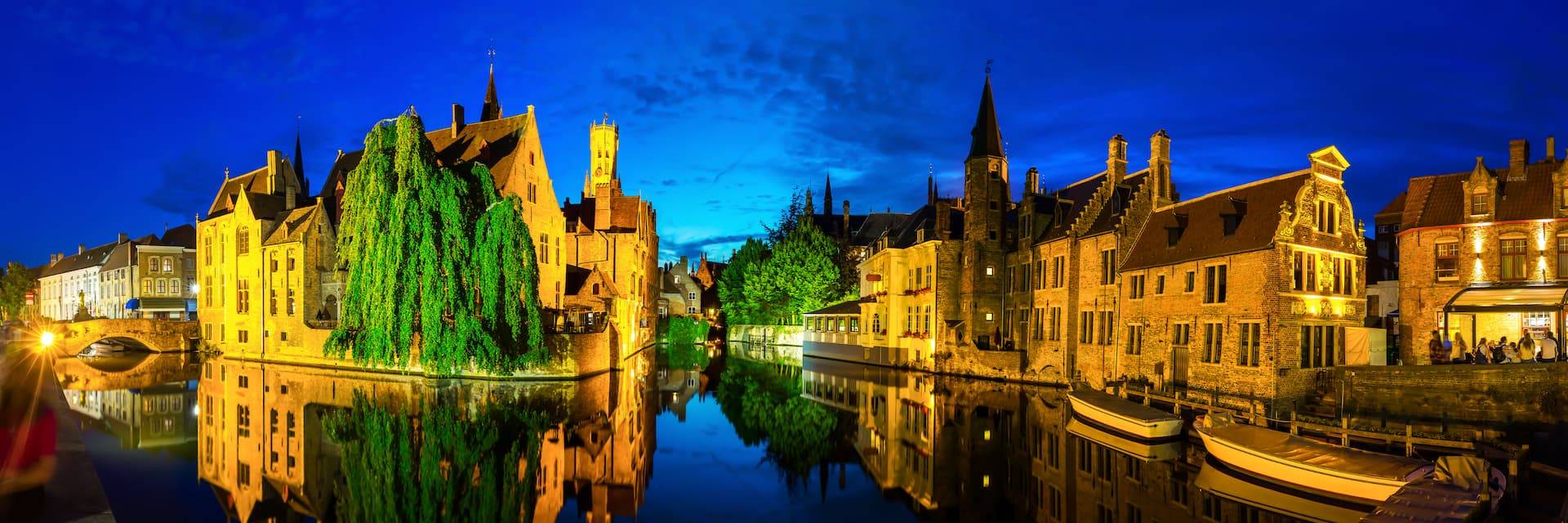
Following the canals you'll reach this iconic quayside — the most recognisable image of Bruges, where the canal curves around a typical Flemish house. This is the spot that perfectly explains why the city is called the Venice of the North. An unmissable photo opportunity.
After exploring Bruges, grab a bite to eat before heading to Ghent. A classic option is Moules et Frites (mussels and chips), Belgium's national dish, available at restaurants throughout the centre.
Free Walking Tour Bruges
Bruges Mysteries & Legends Free Night Tour
Ghent Free Walking Tour : Legends of Ghent
Ghent Free Evening Tour: The Dark Side of Ghent
Ghent in the Afternoon: What to See in Half a Day

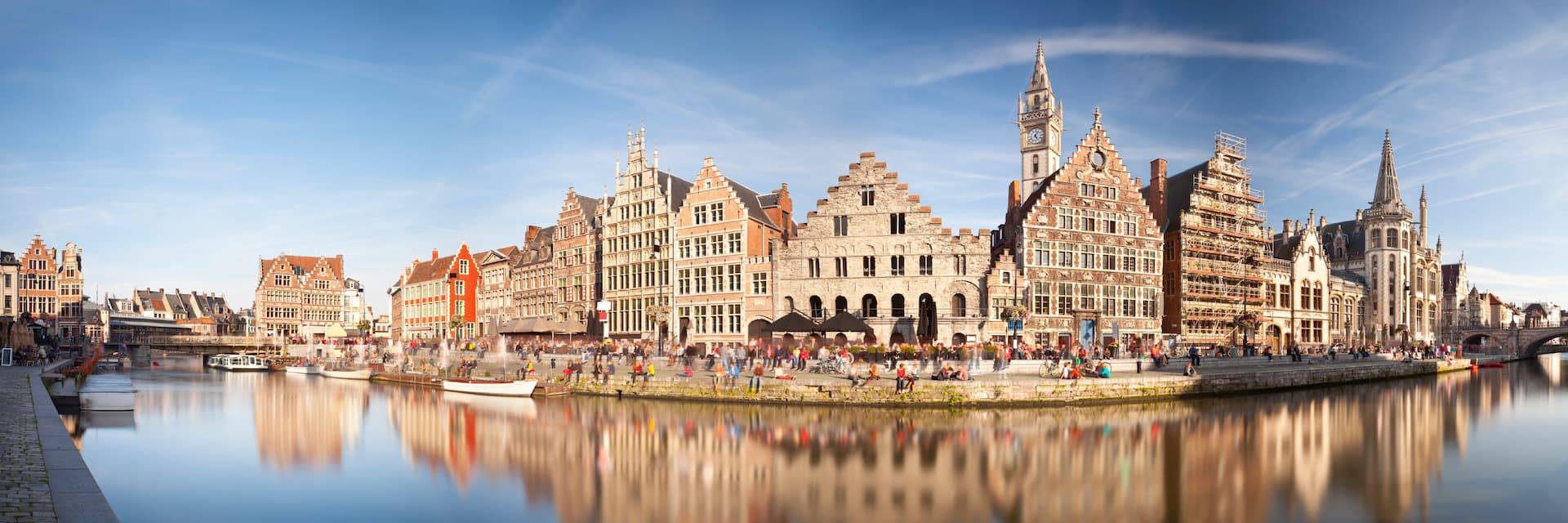
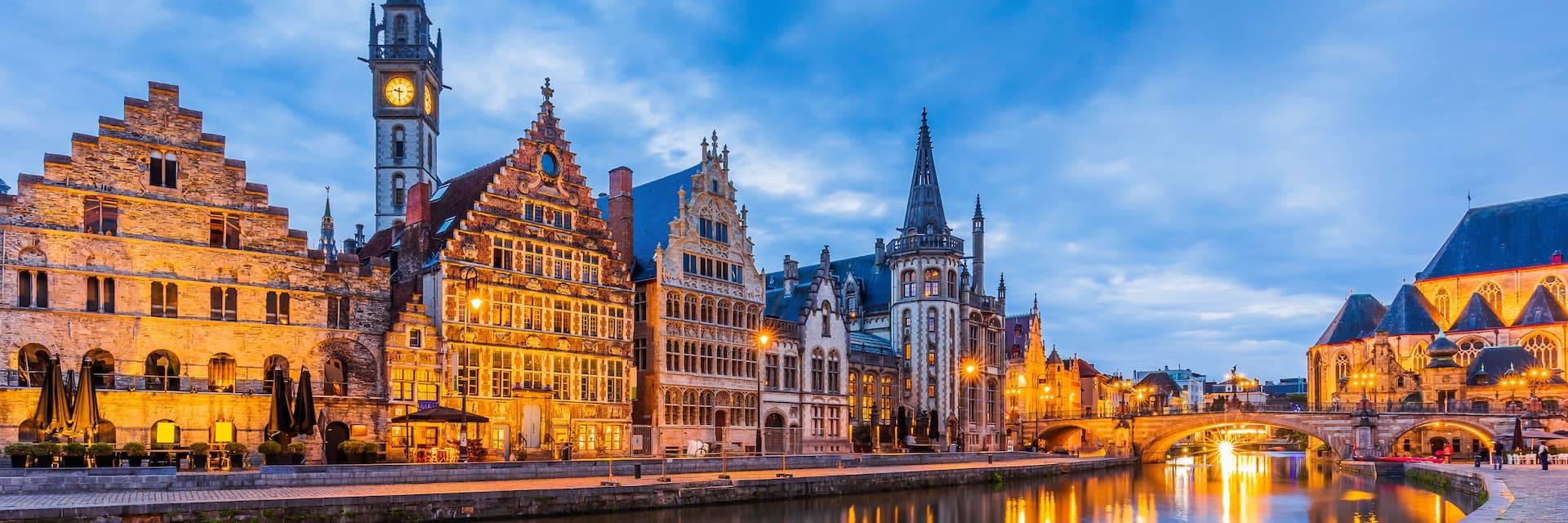
Ghent's historic centre seen from the canal, with its medieval Flemish Baroque buildings
Ghent surprises many visitors who expected something smaller. Despite attracting fewer tourists than Bruges, its historic centre is stunning and full of life. From Ghent-Sint-Pieters station, the centre is about 30 minutes on foot or 10 minutes by tram (line 1, Korenmarkt stop).
To make the most of the time available, the Essential Ghent Free Tour is hard to beat — with morning and afternoon departures, it covers the most important monuments with a knowledgeable guide.
Gravensteen Castle
The tram drops you near one of the city's first major highlights: Gravensteen Castle, the medieval fortress of the Counts of Flanders and one of the best-preserved in Europe. It served as a prison and courthouse over the centuries. Its water-filled moat transports you straight to the Middle Ages. A standout feature is its room of medieval torture instruments. The visit takes around 60 minutes. Open 10:00–18:00. Entry: €14.

Gravensteen Castle in Ghent, one of the best-preserved medieval fortresses in Europe
Graslei and Korenlei Canals
Ghent's most famous canals, lined with small Flemish Baroque buildings dating from the 12th to the 14th century. A view that leaves no one indifferent. There are perfect terraces for a drink while soaking up the atmosphere.
St Michael's Bridge
From this bridge over the River Lys you get the finest views of Ghent's medieval skyline: the city's three towers perfectly aligned — St Bavo's Cathedral, St Nicholas' Church and the Belfry — forming one of the most photographed panoramas in Belgium.

St Nicholas' Church in Ghent, one of the three medieval towers that form the most photographed skyline in Belgium
St Bavo's Cathedral
The most historically significant building in Ghent. This is where Charles V, Holy Roman Emperor, was baptised. Inside, stunning Gothic stained glass windows and masterworks by Rubens and the Van Eyck brothers await. Its 90-metre tower is the best viewpoint in the city.
St Nicholas' Church
Another great medieval Gothic building, next to the Korenmarkt, which houses the largest organ in Belgium. Entry is free. Nearby is the Botermarkt square with Ghent's distinctive City Hall, whose façade blends Gothic and Renaissance styles at a striking corner.
The Ghent Belfry
The enormous tower — a UNESCO World Heritage Site — that completes the city's trio of medieval towers. The views from the top are the best in Ghent. Entry: €8.
Graffiti Alley (Werregarenstraatje)
To end the day on a surprising note, this alley dedicated to street art breaks completely with the medieval atmosphere and reveals Ghent's more alternative side. An unexpected little corner that feels genuinely original. Free entry.
If you still have energy as evening falls, the Dark Side of Ghent Night Free Tour is a spectacular way to close the day, discovering the legends and mysteries of the illuminated city.
Practical Tips for Visiting Bruges and Ghent in One Day
● Start early: To get the most out of the day, aim to be in Bruges before 9:30. The city is far quieter in the early morning.
● Buy train tickets in advance: On the SNCB website you can find deals and avoid queues at the station.
● In Ghent, use the tram: Line 1 connects the station with the centre in 10 minutes. If you're driving, park at the P+R car parks on the outskirts.
● Currency: Euro. Most places accept card, though it's worth carrying some cash for markets and smaller businesses.
● Language: Dutch (Flemish). English is widely understood in both cities.
Free Walking Tour Bruges
Bruges Mysteries & Legends Free Night Tour
Ghent Free Walking Tour : Legends of Ghent
Ghent Free Evening Tour: The Dark Side of Ghent